What to See in the Gothic Quarter
Barcelona's Gothic Quarter packs a Roman temple, a medieval royal palace and a cathedral six centuries in the making into a few minutes' walk. These are the sights you should not leave without seeing, in the order most Gothic Quarter guided tours reach them, with what each costs and what to look for.
Barcelona Cathedral and the cloister
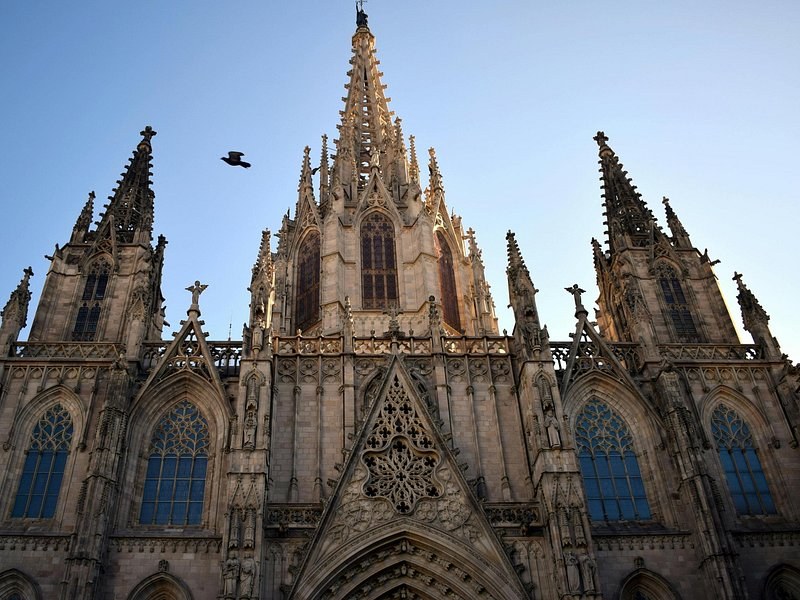
Barcelona Cathedral, the Cathedral of the Holy Cross and Saint Eulalia, stands on Pla de la Seu at the top of the quarter. Building began on 1 May 1298 and was all but finished by the middle of the fifteenth century. The front you photograph is much younger: the façade and its two side towers were added at the end of the nineteenth century, and the work was completed in 1913.
Walk round to the cloister, finished in 1448. Its garden of palms and magnolias sits inside pointed arches, and its pond is home to the Cathedral's white geese. You see the façade for free from the square. To go inside, the cultural visit costs €16, and it also opens the roof by lift, the choir and the Chapter Hall.
- Look for: the geese in the cloister, and the fountain crowned by a knight on horseback.
- Time it: on Sundays the cultural visit opens at 14:00, so see the square in the morning and go in after lunch.
Carrer del Bisbe and the Pont del Bisbe
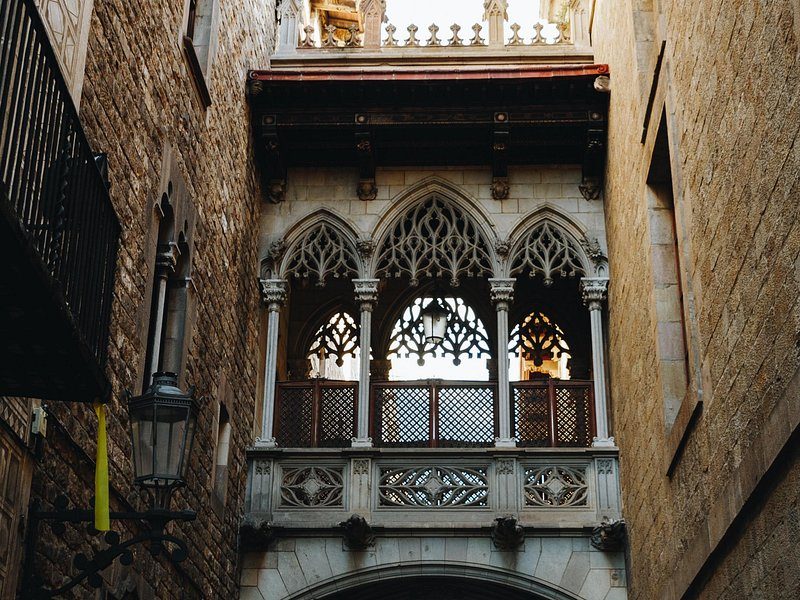
Carrer del Bisbe runs from the Cathedral down towards Plaça de Sant Jaume, and halfway along it a carved stone bridge crosses overhead. This is the Pont del Bisbe, the Bishop's Bridge, and it is the most photographed spot in the quarter.
It looks medieval, and it is not. The bridge is a twentieth-century neo-Gothic addition. That does not make it less worth your time, but it is a good guide's favourite surprise. Look up from directly underneath to see the tracery; step back towards the Cathedral for the classic frame.
Barcelona Cathedral's Santa Eulàlia gate is on this street too. It is the entrance for visitors with reduced mobility.
Plaça del Rei and the Royal Palace
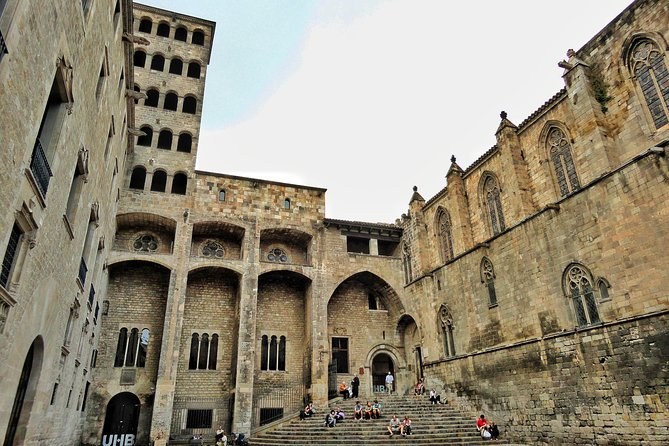
Plaça del Rei is the King's Square, a closed stone square behind the Cathedral. Around you stand the buildings of the medieval Royal Palace: the Saló del Tinell, the Chapel of Santa Àgata, and the tower of stacked arches above the steps. The iron sculpture in the square is Topos V, by Eduardo Chillida, made for this spot.
The square itself is free and open at any hour. Beneath it, the Barcelona History Museum (MUHBA) lets you walk the excavated streets of Roman Barcino, and that part charges. The museum is the subject of things to do in the Gothic Quarter.
Plaça Sant Felip Neri
A few steps west of the Cathedral, down a narrow lane, is a small square with a fountain and a church. It is one of the quietest corners of the quarter, and one of the most visited by guides, for a reason you can see on the church wall.
On 30 January 1938, during the Spanish Civil War, an air raid hit the church of Sant Felip Neri while children were sheltering inside. The shrapnel marks are still visible on the church façade. Guides stop here and speak quietly. Please do the same.
The Temple of Augustus columns
Inside a courtyard on Carrer del Paradís, four Roman columns rise nearly nine metres. They are what stands of the temple of the Roman colony of Barcino, dated to the first century BC and built on the highest point of the small hill the Romans called Mons Taber.
The columns have fluted shafts and Corinthian capitals, with part of the architrave and the podium. They are part of the Barcelona History Museum and free to see. The courtyard is easy to walk past, a couple of minutes from Plaça de Sant Jaume.
Plaça de Sant Jaume
Plaça de Sant Jaume is the civic heart of Barcelona. Two governments face each other across it: the Palau de la Generalitat, seat of the Catalan government, and the city hall. The square sits close to where the forum of Roman Barcino stood, which is why the temple columns are just round the corner.
It is also a meeting point. The evening tapas and wine walk starts here, and a day tour, the sangria walk and the bike tour pass through. Walk north from the square up Carrer del Bisbe and you reach the bridge and then the Cathedral in a few minutes.
Plaça Reial and Gaudí's lampposts
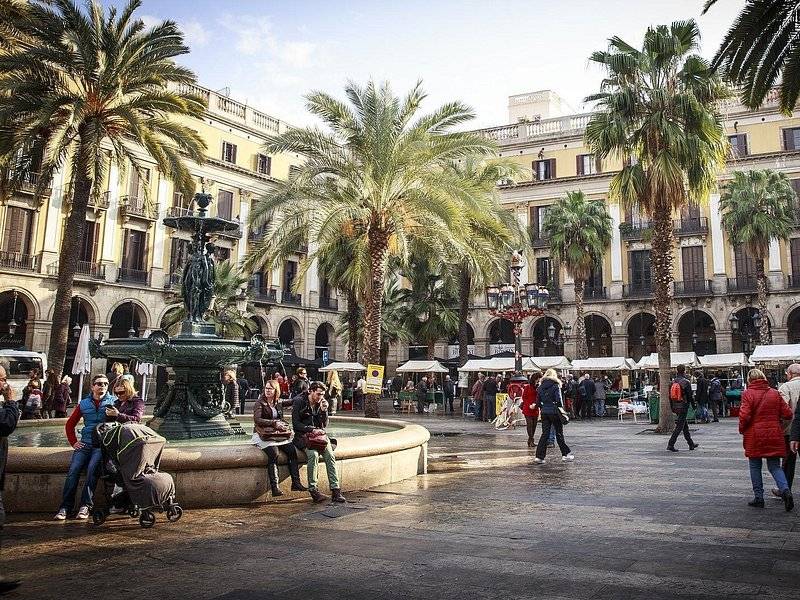
Plaça Reial is a nineteenth-century arcaded square just off La Rambla, with palm trees, a central fountain and café terraces under the arches. It feels different from the medieval lanes because it is: the square was laid out long after the Cathedral was built.
Look at the lampposts. They are by Antoni Gaudí, among his earliest works, long before the Sagrada Familia. The square is busiest in the evening, when the terraces fill.
Which walks stop where
Most walks see the Cathedral from outside and pass through two or three of the squares, but each route leans a different way. Use this to match a sight you care about to a walk that reaches it. The exact start of each one is on the meeting points page.
| Sight | Cost to see it | Walks whose route names it |
|---|---|---|
| Barcelona Cathedral | Free outside; €16 cultural visit | Most walks and the day tours, from outside |
| Pont del Bisbe | Free | The small-group walks that start in El Born or on Plaça del Vuit de Març |
| Plaça del Rei | Free square; MUHBA charges below it | The tapas and taverns walk, the bike tour, the tourist-board walk |
| Plaça Sant Felip Neri | Free | The small-group walks, the tapas and taverns walk, the sangria walk |
| Temple of Augustus | Free | The tourist-board walk |
| Plaça de Sant Jaume | Free | A day tour, the bike tour, the sangria walk; the evening tapas walk meets here |
| Plaça Reial | Free | The Old Town walk, the private walk; the bike tour meets at its fountain |
A walk sells you the stories and the route, not an admission. If you want to go inside the Cathedral or under Plaça del Rei, add that before or after.
Want the stories behind these stones?
The walks put a guide in front of each sight, from Roman Barcino to 1938, from $15 per person.
What to see: quick answers
What is the Gothic Quarter known for?
Is the Gothic Quarter really Gothic?
Is the Temple of Augustus free?
What happened at Plaça Sant Felip Neri?
Do Gothic Quarter tours include entry to the Cathedral?
Next: read how the Roman town became the medieval city on Gothic Quarter history, see where each square sits on the Gothic Quarter map, or compare every tour on Gothic Quarter Tours.